ABOUT
A LIFE BUILT ON BOOKS, QUESTIONS, AND A MORE HUMAN FUTURE.
Author. Artist. Speaker. Worship leader. Professional asker of questions that were apparently supposed to remain rhetorical.
Gabe Ryan’s work moves between music, writing, faith, culture, and public life with one recurring conviction: understanding each other—and the world we’re building together—requires looking longer, listening better, and occasionally admitting the first answer wasn’t good enough.
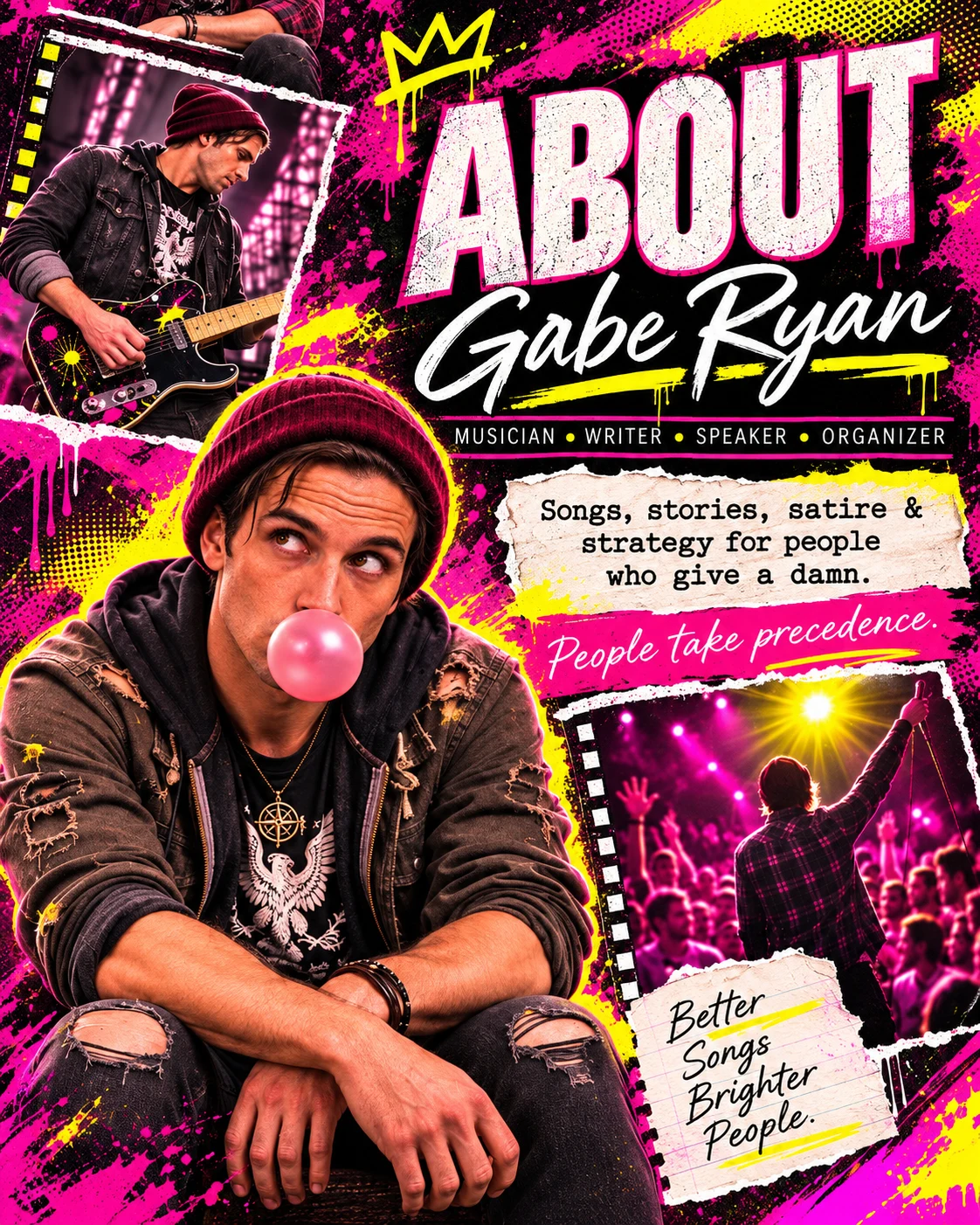
Meet Gabe
Gabe Ryan makes music for people who have questions, convictions, baggage, a sense of humor, and approximately zero interest in pretending those things are mutually exclusive.
A singer, songwriter, author, speaker, and lifelong professional overthinker, Ryan makes big-hearted alternative music where pop-punk urgency collides with theatrical rock, worship-sized melodies, political frustration, spiritual excavation, and the occasional joke that probably should have been removed in editing.
He writes about faith without sanding off the doubt, politics without turning songs into campaign literature, and being human without pretending humanity is particularly tidy. His work can move from an anthem built for a room full of raised fists to a confession that feels accidentally overheard—and sometimes manages both before the final chorus.
Across songs, books, essays, performances, and an expanding body of multimedia work, Ryan keeps returning to the same territory: truth, perception, power, grace, resistance, responsibility, and the million small choices by which people become who they are. The genre changes. The question usually doesn’t: What are you going to do with what you know now?
MY STORY
Gabe Ryan has spent most of his life turning questions into things.
Songs. Books. Essays. Sermons. Projects. Arguments he probably could have avoided.
What began with a kid, a guitar, a church, and an apparently incurable need to understand how things fit together grew into a creative life spanning music, writing, theology, cultural commentary, publishing, and whatever category the next idea inconveniently refuses to fit inside.
The subjects change. The method usually doesn’t:
Look closer. Keep the context. Tell the truth. Make something worth encountering.
“I believe in the power of stories, the importance of asking better questions, and the potential for a more human and hopeful future.” — Gabe Ryan
QUICK FACTS
AUTHOR
Books, essays, and stories built around the questions that refuse to leave quietly.
ARTIST
Alternative music where pop-punk urgency, theatricality, faith, satire, and inconvenient sincerity collide.
SPEAKER
Conversations about faith, culture, creativity, responsibility, perception, and the stories underneath the stories.
WORSHIP LEADER
Rooted in the church, still asking what faith looks like when it survives contact with difficult questions.
PROFESSIONAL OVERTHINKER
Some people let things go. Gabe has historically preferred footnotes.
NORTHWESTERN PENNSYLVANIAN
Making ambitiously difficult things from a corner of Pennsylvania where the trees considerably outnumber the industry meetings.
THE FULL STORY
The longer version.
Gabe Ryan has never been particularly interested in staying in his lane. This would be a more marketable personality trait if he had ever bothered to select a lane.
Singer-songwriter. Author. Worship leader. Speaker. Publisher. Producer. Creative director. Occasional person standing in front of a camera wondering how one innocent idea somehow became a website, a book, three videos, a merchandise collection, a theological argument, and a twelve-tab spreadsheet. So it goes. At the center of all of it, though, is an artist.
Ryan’s work lives at the collision point between alternative rock, pop-punk, theatricality, faith, cultural criticism, and storytelling. The music is melodic enough to sing before you realize what you have agreed to sing, energetic enough to disguise an existential crisis as a good time, and sincere enough that the joke rarely gets the last word. Usually.
Growing up in northwestern Pennsylvania, Ryan was drawn to music long before he possessed anything resembling the qualifications to make it. This has never stopped him from doing much of anything.
His earliest musical instincts came from the church, the radio, the stage, and the particular kind of adolescent conviction that occurs when someone acquires a guitar and immediately assumes events of historical importance are now underway. Formal mastery was less immediate.
Ryan largely taught himself to play guitar from a chord book he found among a collection of piano music. He learned enough to begin writing songs before anyone could intervene. To this day, the unusual fingering of his D major chord provides archaeological evidence that supervision may have been beneficial. But technical orthodoxy was never really the point. Songs were.
Even early on, music gave Ryan a way to do something conversation often could not: hold contradictory things in the same room. Faith and doubt. Anger and compassion. Conviction and uncertainty. Humor and grief. The person you were, the person you are, and the deeply irritating possibility that neither one has the final word. That tension became a defining feature of his work.
Ryan’s songwriting draws from the emotional immediacy of pop-punk and alternative rock, the scale and communal language of worship music, the character-driven drama of theatrical pop, and a lyricist’s fixation on phrases that can change meaning depending on where the light hits them. A song may begin as a joke and turn into an indictment. A political observation may become a confession.
A theological question may become a chorus. A ridiculous title may turn out to be alarmingly sincere. Listeners are advised to remain vigilant. His work is less interested in telling an audience what to think than in making it substantially more difficult not to think at all. That instinct extends far beyond music.
Ryan’s creative life has grown into an interconnected body of songwriting, books, essays, visual storytelling, civic education, devotional writing, and cultural commentary. On paper, these can look like wildly different pursuits. To Ryan, they are variations on the same assignment. Look closer. Tell the truth. Pay attention to context. Notice who benefits from the version of reality everyone has been handed.
And once you see something clearly, decide what responsibility comes with having seen it.
That philosophy sits near the center of Battle Hymns for Our Republic, Ryan’s 2026 album exploring citizenship not as spectacle, branding, or abstract patriotism, but as an accumulation of choices. The project asks what resistance looks like when history is not occurring somewhere else, performed by more important people with better lighting. Sometimes resistance looks enormous.
Sometimes it looks like telling the truth. Showing up. Voting. Listening. Speaking when silence would be easier. Admitting you were wrong. Helping your neighbor. Refusing to allow someone else to choose your enemies for you. Choosing compassion without surrendering conviction. Choosing courage without surrendering humanity. A million little things.
The album’s sonic world mirrors that idea. Alternative rock, pop-punk, theatrical flourishes, worship-sized choruses, intimate storytelling, and flashes of satire coexist without politely waiting for their respective turns. The result is less a collection of songs about politics than a record about what politics eventually reaches: people. Their relationships. Their beliefs. Their fears. Their choices.
Their responsibility for one another.
Its companion work, Battle Hymns for a Resisting Republic, extends those ideas beyond the record, continuing Ryan’s tendency to treat an album not as an isolated product but as the center of a larger narrative world. That tendency appears throughout his catalog. Ryan writes songs as though they may have to survive outside the speakers.
They become essays. Visuals. Devotionals. Stories. Arguments. Performances. Questions that refuse to leave when the track ends. Faith remains one of the deepest threads running through that work.
Ryan came into music through worship, and Christianity continues to shape his writing—but rarely as a shortcut around complexity. His work is particularly concerned with the distance between the teachings people claim and the systems, habits, identities, and politics they build around those teachings. He is interested in belief sturdy enough to withstand examination. Grace that does not require dishonesty.
Conviction that does not require cruelty. And a God who is considerably less threatened by questions than many of His public-relations representatives appear to be. That same instinct informs Ryan’s humor.
Because although his work regularly wanders into theology, democracy, grief, power, manipulation, identity, mortality, and the decline of Western civilization before lunch, Ryan remains deeply suspicious of the idea that seriousness requires behaving seriously at all times. Humor, in his work, is not an escape hatch. It is often the delivery system. A joke lowers the drawbridge. The truth walks in behind it.
Then somebody realizes what happened. By then, ideally, there is already a chorus.
This balance—between sincerity and satire, sacred and ridiculous, personal and political—is ultimately what connects Ryan’s increasingly difficult-to-explain collection of creative endeavors. The medium changes. The method usually does not. Pay attention. Look again. Question the framing. Keep the context. Laugh when appropriate. Laugh when inappropriate, but perhaps more quietly.
Tell the truth as accurately as you can. Correct yourself when you learn more. And refuse the comforting fiction that choosing not to participate somehow removes you from the consequences. Ryan has described one of the convictions underlying his work simply: Not engaging is engaging. Not choosing is a choice.
His career, accordingly, has become less about constructing a perfectly categorized artistic identity than about following that conviction wherever it leads. Sometimes that leads to a stage. Sometimes a church. Sometimes a recording studio. Sometimes a manuscript. Sometimes directly into an argument he absolutely could have avoided. But the objective remains remarkably consistent. Make something worth encountering.
Say something worth considering. Leave room for people to disagree. Leave considerably less room for them not to think. And, whenever possible, give them something they can scream along to while they do.
READ
WORDS, WITH OCCASIONAL PARAGRAPHS.
Books, essays, [RE:Written], and the ideas that needed more room than a chorus could provide.
LISTEN
THIS PART HAS A SOUNDTRACK.
Music, podcasts, and the assorted evidence that some ideas are considerably better with drums.
WATCH
NOW WITH MOVING PICTURES.
Videos, conversations, performances, shows, and other situations in which someone unfortunately remembered to turn the camera on.
SHOP
TAKE SOMETHING WITH YOU.
Books, music, apparel, prints, and tangible evidence that you were here.