MUSIC + BOOK
BATTLE HYMNS
SONGS FOR THE FIGHT. TRUTH FOR THE JOURNEY.
An album and a companion book exploring faith, resistance, responsibility, perception, citizenship, and the million little choices by which ordinary people decide what kind of country—and people—we become.

TWO PARTS. ONE CONVERSATION.
THE SONGS START IT. THE BOOK TAKES IT FURTHER.
Battle Hymns was never conceived as a soundtrack with some additional reading attached.
The music and the book approach the same questions from different directions: one through melody, tension, anger, hope, satire, confession, and volume; the other through Scripture, reflection, context, and the uncomfortable luxury of having more than four minutes to finish a thought.
You can begin with either.
They were built to eventually meet.
THE ALBUM
THE FIGHT OUTSIDE.
Alternative rock, pop-punk urgency, theatrical flourishes, worship-sized choruses, and songs about resistance—not as spectacle, but as the ordinary decisions people make when truth becomes inconvenient and participation would be easier to outsource.
It is music about faith, frustration, power, compassion, responsibility, and what happens when “somebody should do something” eventually has to include somebody.
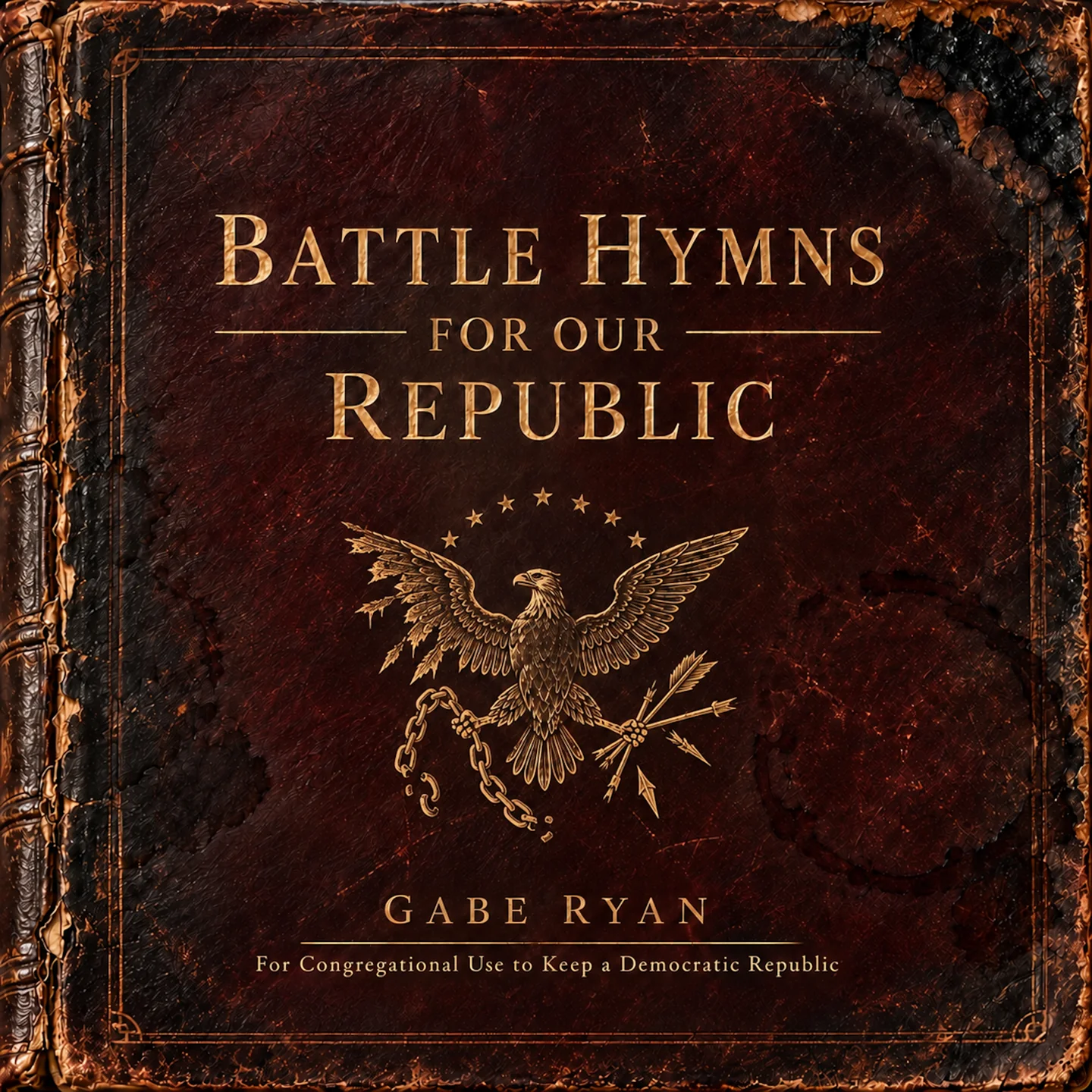
BATTLE HYMNS FOR OUR REPUBLIC
Streaming links and the approved tracklist have not been added yet.
THE DEVOTIONAL COMPANION
THE WORK INSIDE.
The songs raise questions that a chorus cannot responsibly answer.
Battle Hymns for a Resisting Republic carries them onto the page through Scripture, reflection, biblical case studies, cultural context, and practical examinations of truth, perception, power, citizenship, grace, responsibility, and resistance.
It is not a devotional about how to win a political argument.
It is about becoming the kind of person who can resist what is wrong without surrendering what is right in the process.
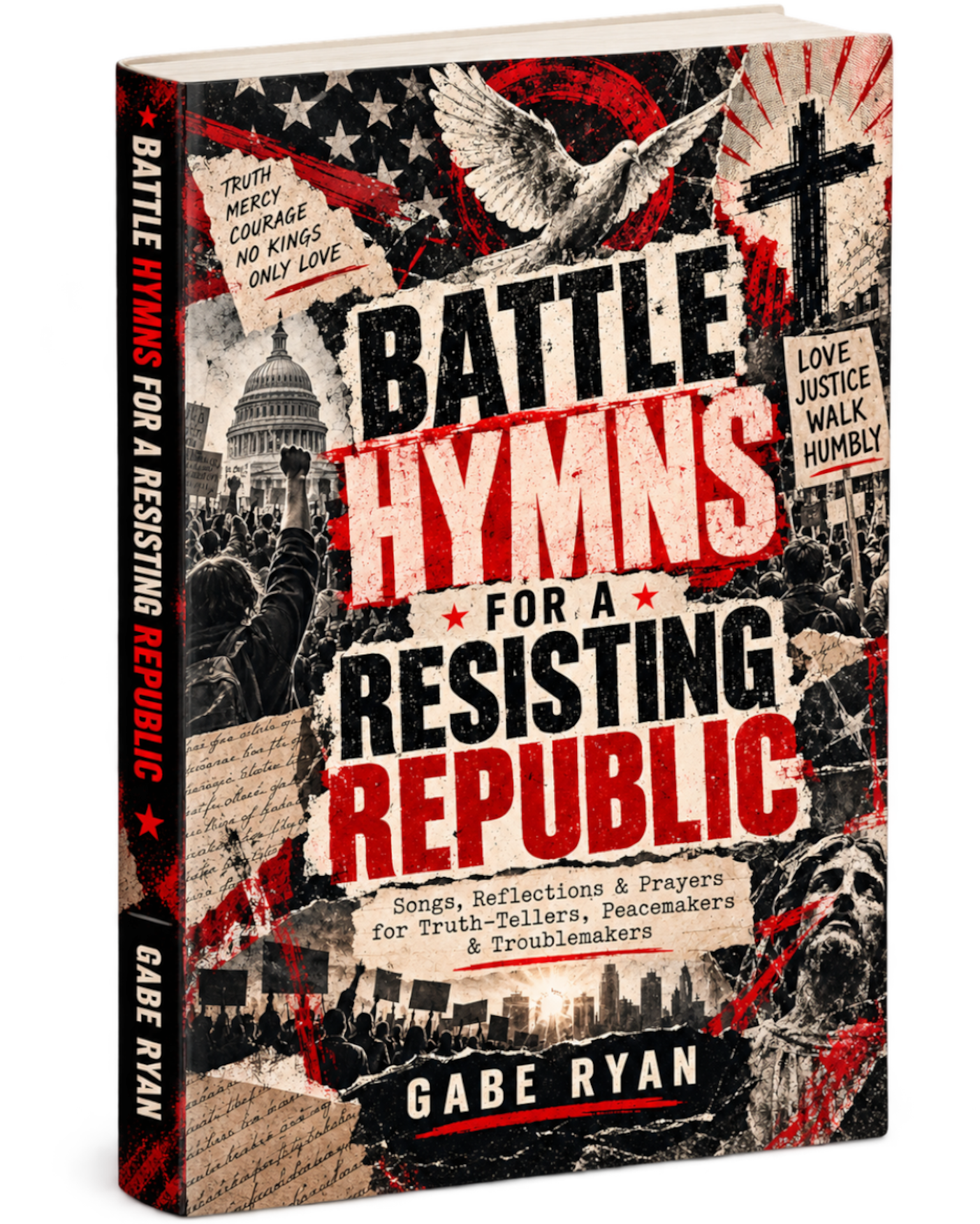
BATTLE HYMNS FOR A RESISTING REPUBLIC
Purchase options will appear when the store is connected.

THE STORY BEHIND THE PROJECT
A PROJECT FOR REAL LIFE.
There is a version of resistance that looks very good on a poster.
This project is mostly interested in the version that happens when nobody is watching.
Telling the truth when the lie would be easier. Showing up. Listening before answering. Voting. Admitting you were wrong. Helping your neighbor. Refusing the invitation to turn another human being into an assigned enemy. Choosing compassion without surrendering conviction. Choosing courage without surrendering humanity.
History is built from enormous moments.
But enormous moments are built from millions of smaller ones.
Battle Hymns is about those.
THE STORY BEHIND THE PROJECT / GABE RYAN
WHY BATTLE HYMNS?
I did not set out to make a political album.
That sentence probably requires some clarification, considering I eventually made an album called Battle Hymns for Our Republic and then wrote an entire devotional companion called Battle Hymns for a Resisting Republic to go with it.
So, yes. Point taken.
What I mean is that I was never particularly interested in making a collection of songs about politicians.
Politicians already receive an extraordinary amount of attention for people whose job descriptions are supposed to involve representing the rest of us.
I was more interested in the rest of us.
The people watching. The people voting. The people arguing. The people checking out. The people deciding whether to say something. The people deciding whether to listen. The people who know something is wrong but have absolutely no idea what they are supposed to do about it before dinner.
Because somewhere along the way, I became increasingly convinced that we misunderstand how history actually happens.
We remember the speeches, the elections, the protests, the wars, the court decisions, the names printed in textbooks.
But those moments do not appear from nowhere.
They are built.
Usually slowly.
Usually by people who have no idea they are currently participating in something historians will eventually give a chapter heading.
History is made of a million little things.
And so are we.
There is a television show called A Million Little Things. I first watched it with my friend Katie. Later, I watched it again with my mom.
The title has always stuck with me—not because this project is about the show, but because there is something almost annoyingly true about the phrase itself.
Lives are not generally changed by one enormous decision.
They are changed by thousands of small ones.
Relationships work that way.
Faith works that way.
Character works that way.
Countries do too.
We like dramatic moments because they provide clean narratives. There is a before, an event, and an after.
Real life is considerably less cooperative.
Most of the important things happen incrementally.
You tell the truth this time.
Then the next time.
You let the lie go unchallenged this time.
Then the next time.
You listen to somebody you have been trained to dismiss.
You decide not to.
You show up.
You stay home.
You vote.
You assume somebody else will.
You admit you were wrong.
You construct an increasingly elaborate intellectual fortress around the possibility that you have never been wrong about anything in your life.
You help the person in front of you.
You decide they are somebody else’s problem.
None of these decisions feels like history.
That is precisely the problem.
For a long time, I had a fairly tidy way of understanding the political spectrum.
I thought conservatives existed to make sure some lines were crossed, and liberals existed to make sure some lines were not drawn.
One side kept us from freezing every boundary in place forever. The other kept us from erasing every boundary simply because somebody found it inconvenient.
In my head, that tension was healthy because both sides were ultimately trying to protect the same thing from different directions.
I still think there is something valuable in that instinct.
But it only works if there is still a shared goal.
It only works if the disagreement is over how to build the house, not whether the people standing on the other side of the room deserve to live in it.
Once politics becomes less about disagreement over how to reach a shared destination and more about defeating the people you have been taught to regard as enemies, balance stops being balance.
It becomes sabotage.
And that realization sits underneath a lot of Battle Hymns.
Because I am increasingly uninterested in the question of which side is winning.
I am much more interested in what we are becoming while we try.
You can defeat something terrible and become terrible in the process.
You can defend something good so viciously that you destroy the very thing you claimed to protect.
You can be correct about the danger and catastrophically wrong about what the danger permits you to become.
That is why this project keeps returning to compassion, conviction, courage, responsibility, perception, and grace.
Resistance matters.
So does the person doing the resisting.
When we hear the word resistance, we tend to imagine extraordinary circumstances.
Marches. Underground movements. Whistleblowers. Civil disobedience. Someone dramatically printing forbidden literature in a basement by candlelight.
And sometimes resistance does look like that.
But if resistance only begins once everything is already on fire, we have misunderstood the assignment.
Most resistance happens much earlier.
It looks like refusing to repeat something simply because everyone on your side is repeating it.
It looks like asking for the source.
It looks like noticing when fear has started doing your thinking for you.
It looks like listening before deciding what somebody believes.
It looks like speaking when silence would be more comfortable.
It looks like shutting up when speaking would only make you feel important.
It looks like helping your neighbor.
Showing up.
Voting.
Apologizing.
Changing your mind.
Refusing to treat another person as an enemy simply because somebody with an audience assigned them that role.
Choosing compassion without surrendering conviction.
Choosing courage without surrendering humanity.
These are not particularly glamorous acts.
They do not always photograph well.
Nobody necessarily applauds.
And yet these are precisely the decisions from which larger moments are eventually constructed.
By the time resistance becomes cinematic, millions of smaller choices have already been made.
The album became the place where I could feel all of this before I fully explained it.
Songs are useful that way.
They let contradiction exist.
Anger and hope can occupy the same chorus.
Faith and doubt can stand next to each other without one immediately filing an eviction notice.
Satire can expose something that an argument merely describes.
A melody can carry a question past the defenses that prose sometimes triggers on sight.
So Battle Hymns for Our Republic became a record about the external struggle: power, propaganda, perception, money, fear, tribalism, faith, civic responsibility, and the bizarre stories human beings tell ourselves when reality has become inconvenient.
But underneath all of those subjects was something more personal.
Every song kept turning the camera around.
It is easy to write about them.
What they did.
What they believe.
What they refuse to see.
Eventually, a worthwhile song asks what you are doing.
That became the album’s real territory.
Not merely: what is happening?
But: what does what is happening require of you?
And then I ran into a problem.
Songs end.
Questions frequently do not.
There are things you can responsibly explore in three or four minutes.
There are other things that absolutely should not be reduced to a bridge and final chorus.
The deeper I got into the material, the clearer it became that the album needed a companion.
Not a lyric book.
Not liner notes.
Not an explanation of what each song “means,” as though art is a multiple-choice test and I possess the answer key.
Something else.
A place to slow down.
To open Scripture.
To examine stories about power, fear, consensus, status, perception, resistance, and responsibility that are considerably older than our current news cycle.
To ask what faithfulness looks like when the world around you is very loudly demanding allegiance to something else.
That became Battle Hymns for a Resisting Republic.
The album deals heavily with the fight outside.
The devotional asks about the work inside.
Because resistance that never examines itself eventually becomes another form of domination.
Because conviction without humility becomes arrogance.
Compassion without conviction becomes avoidance.
Courage without humanity becomes cruelty.
And faith without examination can become remarkably useful camouflage for almost anything.
The point is not to emerge from the book with better ammunition for your next argument. If anything, I hope it makes ammunition less interesting.
What I want is for the reader to become harder to manipulate—not because they have memorized a better set of talking points, but because they have learned to recognize the machinery underneath them. Fear. Group loyalty. Flattery. Grievance. Selective context. The strange psychological comfort of hearing exactly what we already wanted to believe.
That matters because none of us is immune to it. People of faith are not immune to it. People who think of themselves as thoughtful are not immune to it. People who have correctly identified manipulation in somebody else are not thereby protected from being manipulated themselves.
Sometimes the most dangerous thing about recognizing propaganda is how quickly it can convince you that only the other side uses it.
That is part of why the devotional spends so much time in Scripture. Not because I think the Bible functions as a political field manual, but because human beings have been wrestling with these same dynamics for a very long time. Fear becomes consensus. Consensus becomes pressure. Advice becomes permission. Grievance becomes recruitment. Power learns how to describe itself as protection. Communities become so invested in preserving their own story that reality begins to feel like an attack.
None of that began with cable news. None of it began with social media. And none of it disappears simply because we can recognize it in somebody else.
That is where the internal work becomes inseparable from the external fight.
If I want to resist manipulation, I have to be willing to notice the ways I am manipulable. If I want to resist dehumanization, I have to pay attention to the moments when contempt starts feeling righteous. If I want to defend truth, I have to be willing to lose an argument when the facts require it. If I want to oppose cruelty, I cannot give myself a moral exemption to become cruel in the process.
That sounds obvious when written cleanly on a page. It becomes considerably less obvious when the person being corrected is me.
That, more than anything, is why I do not think Battle Hymns is a project about being right.
Being right matters. Truth matters. Facts matter. There are real differences between accurate and inaccurate claims, just and unjust systems, compassionate and destructive policies.
But being correct about one thing does not confer moral immunity everywhere else.
You can identify a real threat and still respond to it badly. You can defend something worth defending and still become dishonest while doing it. You can possess the better argument and still treat people beneath the dignity your argument supposedly protects.
So the question underneath the project became less about whether somebody had chosen the proper political team and more about whether they were becoming the kind of person who could recognize truth even when truth became inconvenient to their team.
That is a much more expensive kind of loyalty.
It may require admitting that somebody you dislike made a valid point. It may require acknowledging that somebody you trust did something wrong. It may require refusing a narrative that feels emotionally satisfying because the evidence does not support it. It may require saying, “I was wrong,” without immediately attaching seventeen paragraphs explaining why you were still basically right in spirit.
I am not especially interested in pretending those things are easy.
I am interested in whether they are necessary.
That is also where hope enters the project.
I do not think hope is optimism, and I definitely do not think it is the emotional equivalent of putting a motivational poster over a structural crack and deciding the building is fine.
Hope, to me, is much more demanding than that.
Hope is the belief that action remains meaningful.
If nothing can change, responsibility becomes pointless. If nobody can be persuaded, conversation becomes theater. If relationships cannot be repaired, apology becomes ceremonial. If institutions cannot be improved, participation becomes irrational.
Cynicism solves all of that very neatly.
It tells you that everything is corrupt, everybody is compromised, nothing matters, and therefore your disengagement is not surrender but sophistication.
That is an incredibly comfortable worldview because it asks almost nothing of you.
You can stand at a safe distance from every failure and explain why you expected it. You can avoid the embarrassment of hoping for something that does not happen. You can avoid the vulnerability of caring. You can even mistake detachment for wisdom.
I understand the temptation.
I just do not think we can afford it.
A more human future is possible.
I do not say that because I think progress is automatic. History provides far too much evidence against that.
I say it because the alternative—that our choices no longer matter—is both untrue and extraordinarily useful to anyone who would prefer that ordinary people stop making them.
Possible is not the same thing as inevitable.
That distinction is the whole point.
A better future requires participation precisely because it is not guaranteed.
And that brings me back to the title.
Why Battle Hymns?
Because battles are already being fought, whether we choose the language or not.
Some are political. Some are cultural. Some are institutional. A surprising number happen across kitchen tables. Some happen in churches. Some happen in group chats. Some happen in that brief private moment after you discover that the thing you just repeated is not actually true and have to decide whether correcting yourself is worth the embarrassment.
That counts too.
And a hymn, at its best, is not merely a song about what somebody believes.
It is a way of remembering.
You sing something because there are truths human beings are remarkably good at forgetting the moment fear, anger, status, or self-interest becomes louder.
That is the sense in which I mean Battle Hymns.
Not songs for conquering enemies. Not partisan anthems. Not marching orders.
Songs for remembering who we are supposed to be while we are fighting for what we believe matters.
The album can do that emotionally. It can put tension, anger, grief, absurdity, faith, and hope in the same room and let them argue over the speakers.
The devotional can slow the conversation down enough to ask what all of that requires once the music stops.
That is why the two pieces belong together.
The record looks outward at the structures, stories, powers, fears, and failures shaping public life.
The book turns the question inward and asks what happens when those forces reach us.
Because eventually they do.
They reach our language, our loyalties, our relationships, our assumptions, our definitions of who deserves empathy, and our willingness to tell the truth when the truth becomes socially expensive.
And at that point, resistance is no longer theoretical.
It becomes personal.
That is the question I kept finding underneath the songs, underneath the devotional, and eventually underneath the entire project:
WHAT ARE YOU GOING TO DO WITH WHAT YOU KNOW NOW?
Not once history has settled the argument for you. Not once the consequences are obvious. Not once somebody more qualified arrives.
Now.
Because if history really is made of a million little things, then history is not merely something happening around us.
It is something passing through us.
Through the things we repeat, the things we excuse, the things we challenge, the people we defend, the people we dismiss, the moments when we speak, the moments when we listen, and the moments when we decide that doing the small right thing is still worth doing even though nobody is going to write it down.
Someday, people may look back at this period and reduce it to a handful of elections, court decisions, movements, scandals, leaders, and crises.
That is what history books have to do. They compress.
But underneath every headline will be millions of ordinary decisions made by people who mostly thought they were just getting through another day.
That is where this project lives.
Not in the fantasy that every choice changes the world.
In the conviction that every world-changing moment is made out of choices.
And so are we.
WHAT ARE YOU GOING TO DO WITH WHAT YOU KNOW NOW?
The record can end.
The responsibility does not.